
The Immersive Story
From 360 to Virtual Reality

Due to technological, social and industrial advances and the digitization of media, journalism as a practice, a business and an institution is facing many challenges as well as opportunities. Recent key technological progresses in journalism have focused on social media, mobile applications and online video.
It is somewhat vital for journalists and news organizations to always stay updated with the current trends and technological advances.
 Some news organizations, most notably The New York Times, The Huffington Post and The Guardian, have gone on board with creating 360° video to take advantage of the popularity of video news, social and mobile media.
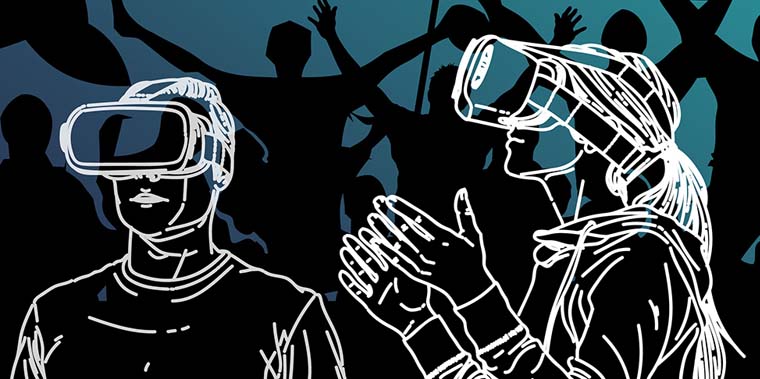
The key disruption caused by VR and 360° journalism is the shift from an informative to a narrative practice — where the audience actually enters a virtually recreated or recorded scenario representing the news story.
Complementary skills are needed for journalist to engage in VR and 360° video, such as skills in producing, film direction, video-editing, videography, etc.
VR and 360-degree videos, whose market is on the rise, can enhance journalists’ storytelling potential by offering experiences and environments to news users that are unique, and thus lead to more engaged users.
We advise journalists and news organizations that plan to take steps in the production of VR and 360° video for news stories to keep in mind to, at first, focus on specific types of stories until further research is conducted. Second, we also stress that VR and 360° videos won’t replace TV, print or radio — even if they can be used in numerous ways,

A deep dive into VR and 360° video
Any time a new technology is introduced in an industry, people react to it with uncertainty and reluctance. The field of journalism is no different.
What is VR?
Virtual reality is an immersive experience that reproduces either a real or an imagined three-dimensional and computer generated environment, which allows the users to immerse themselves in it and interact with it as if they were really there.
At the moment, virtual reality and immersive storytelling come in several forms: Virtual Reality, which produces a virtual world via Computer Generated Imagery (CGI); Augmented Reality, which starts with the real world and overlays virtual objects and information; and 360° Video, which records a real-world scene in which the viewer can look up, down and around. This white paper will refer to, particularly, the last method in news making and journalistic storytelling.
What is 360° video?
360° video is a form of shooting and experiencing video that allows the user to look in all the directions of a video-recorded scene. In 360° video or spherical filmmaking, the user, or the audience, no longer looks straight to a flat framed image, but explores the video by moving the fingers (by swiping the image around) or by moving a device like a smartphone or a tablet. 360° video can also be enjoyed in a VR headset although it doesn’t mean all 360° video is virtual reality.
Why are 360 video and VR relevant for journalists?
Before the introduction of digital and communication technologies, the field of journalism was based on high market power over distribution platforms, mass audience, and mass advertisers, and the public’s access to news and entertainment was restricted through time and space. However, due to technological, social and industrial advances and the digitization of media, these constrains have loosened, and new biases in the social structure have been created. As a result, society is no longer as heavily dependent on traditional media (newspapers, TV and radio) as before since people can easily access news with a click of a few buttons (or with a few touches on their smartphones/tablets). Journalists and news organizations should be aware of the fact that these innovations lead to a stronger competition for news users’ attention, and an important way to win that battle is by differentiating yourself through a competitive advantage.
As a consequence, news organizations cannot but direct their gaze towards new trends and technologies. Recently, journalists have turned to powerful 360° videos in journalistic storytelling. Leading news organizations from The Wall Street Journal to Euronews, The New York Times, The Associated Press and The Guardian are experimenting with these techniques. They showcase user-generated content around breaking news on social media, more specifically on Facebook and YouTube — which in turn have come on board with this movement and launched YouTube 360 and Facebook 360. The fact that both of these social media are supporting 360° videos is a shot in the arm for the promising industry of virtual reality filmmakers. Also, it is a call for journalists — whose reliance on social media has already increased over the years — to benefit from these opportunities and create new strategies.
How can VR and 360° video disrupt journalism?
The VR medium challenges core journalistic questions such as “Who is the journalist?”, “Who does the journalist represent?”, “Are users, invisible bystanders in the scene? Do they inhabit the journalist’s position and role?”, “Is the journalist (and her or his team) in the field of view?”, “Is the journalist the guide to the experience?”. All of these questions represent possible significant changes for the practice of journalism.

First, VR and 360° video require journalists to connect more with the storytelling side of news production. Journalists aim foremost to inform the public. In VR and 360° video, however, the viewer “enters” a digitally represented world through a traditional computer interface. The viewer can look around, up and down the scenery while listening to the recited news story, and he/she can investigate different topics and aspects of the underlying news story. This offers a method of navigation and an experience that is much more entangled with the narrative structure, a type of interactive journalism called Immersive Journalism.
This requires another approach at telling the news, one where journalists act more like film-makers and narrators aspiring to convey not only information, but also an emotional connection with the news. VR journalists have a strong interaction with their audience and also seek to encourage them to take action. Next to the fact that not all journalists might feel comfortable with this approach, there is also the concern that the user’s ability to control elements of the experience risks masking the editorial aspect of the journalist’s work.
Second, next to this more emotive approach to journalism, the whole process from capturing through viewing VR and 360° video requires a wide range of specialist and professional skills. A project like VR or 360° video creation entails team members that have skills in producing, film direction, video-editing, coding, videography and many other technical aptitudes. It is impossible for a journalist to perform all of these roles. Thus, there should be collaboration between an editorial team and a digital production one. Journalists should accept the fact that news making is no longer a linear top-down process, but rather a collaborative one.
Accordingly, VR and 360° journalism may not be a profitable business at first (like many other new businesses). However, it is important to note that future investments in VR technologies are forecasted to increase. Also news corporations believe that the introduction of this new technology has the potential to add great value by adding new subscribers, and hence, increase their revenues.
Key opportunities & challenges
VR and 360° journalism might come with disruptions, but also with important opportunities for the future of journalism.
VR and 360° video have the potential to enhance storytelling by offering experiences and environments to their viewers that are out of their reach.
However, right now and for the probable future, the truth is that not every news story is suited for virtual reality. Currently, it is more of a complement to other forms of reporting than a platform that can replace them. However, the potential for impacting audiences is quite appealing.
Shaping more engaging user experiences
360° video motivates viewers to watch and interact more and it drives viewers to share, subscribe, and view other videos. 360° videos also have a higher click-through rate, meaning that viewers are more interested in checking out the full-length version of the video.
New forms of journalism, new norms and ethics
 360° coverage comes with a few risks, such as the inability of excluding potentially graphic aspects from a scene or exposing one’s privacy, and creating uncomfortable, frightening or misleading experiences through the “immersive experience” of 360° videos. Nevertheless, the latter should not be regarded as a disadvantage since one of the main purposes of VR journalism is to push the audience to empathize with the situation.
At the same time, VR prompts the question: how accurate and factual should a virtual story be? Is it ethical to abbreviate an experience to only incorporate the most impacting moments? In the natural consolidation of detailed reality into a story, the threshold for ethical manipulation is hazy [12]. In their efforts to convey a strong emotional message through immersive experiences, journalists will have to carefully guard the balance between story and facts.
Final notes: the virtual road ahead
At the moment, VR and 360° are experiencing a strong momentum. Whether the technology will consolidate in the field of journalism — and in general — remains to be seen. It is common-sense for journalists to fear whether or not viewers will want to continue watching these videos after the initial “trendy” factor wears off. It will anyways be a challenge for them to create content in a way that would encourage news users to stick around and remain engaged.

Hence, journalists should mainly use 360° storytelling to report, for example, post-war repercussions, controversial stories (such as the repercussions of drunk driving or life in solitary confinement), and other social, political and economic stories/documentaries such as climate change. Also they should use VR in their storytelling for environments where people are unlikely to go, for instance war zones. In other words, cover stories where a 360-degree view of the scenery would deepen the viewer’s empathy towards the story beyond a written narrative, photos or regular video.
VR and 360° video is rapidly developing; hence, journalists should keep in mind this medium’s potential in the industry their part of. This technology is actually built for film and gaming worlds. Journalism is a small section in this emerging ecosystem. This should encourage journalists to jump in and experiment which could lead to the further development of VR technologies and processes that suit their needs and benefit their audiences.
To conclude, virtual reality is another disruption of traditional journalistic competences with technology that has started creating waves in the field of journalism. These technologies not only have increased elements of accuracy, reach, feel but also have started questioning the 'human element’ of 'newsmakers ’or 'news consumers.’ If used appropriately, VR and 360° could offer promising paths for journalistic innovation.
Editorial:
Baseem Mayala
Content Developer / Audiovisual Expert